Franchising

Nobody else gets to fly your town.

A SkySlice territory is a circle on a map with one operator inside it. You run the pad and the kitchen. We run the aircraft, the airspace and the paperwork.

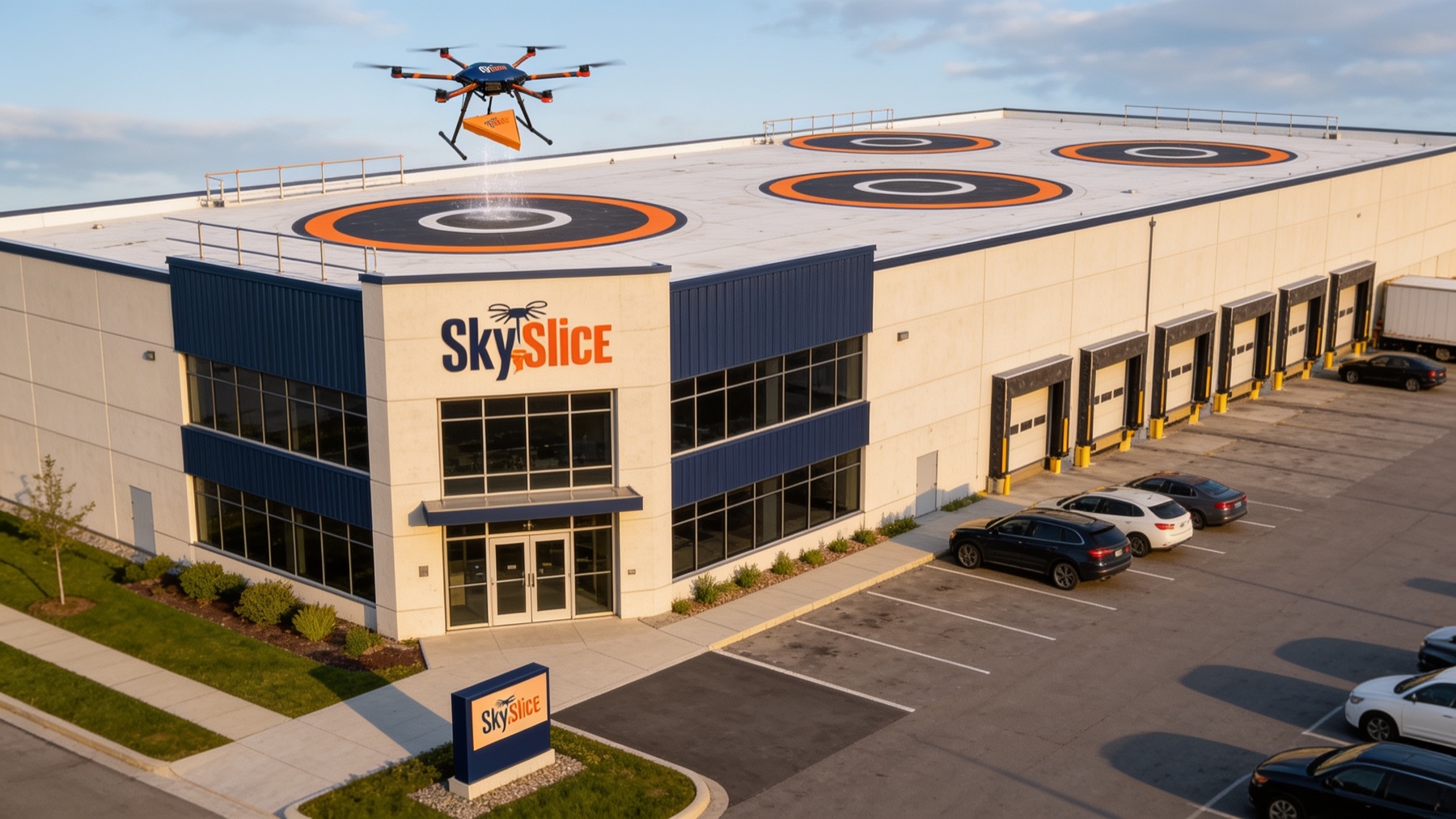
A low-rise SkySlice facility in a business park with rooftop drone launch pads
A single-territory pad. Nineteen hundred square feet of kitchen, a roof, and about fourteen square kilometres of exclusivity above it.

Why the numbers work differently up here

Every pizza business on the ground is really a driving business. It pays for a dining room it half fills, a parking lot it never uses, and a fleet of couriers sitting at the same red light as everybody else. Its delivery radius is not a radius at all — it is a drive time, and it collapses every day at five o'clock, which is exactly when the orders arrive.

Ours is a circle. It is the same size at 5:20 on a Friday as it is at two in the afternoon, because nothing we own has ever been in traffic. That single difference is the whole business case, and it is why a SkySlice pad serves more households from less floor space than anything else in food service.

You are not buying a restaurant. You are buying the airspace over one.

What you get

01

A territory with a hard edge

One operator per zone, drawn as a real polygon and registered against your agreement. No other SkySlice aircraft may release a box inside it, including ours. We have been on the wrong side of a delivery boundary, and we do not do that to our own people.

02

No dining room. No drive-thru. No lot.

Nineteen hundred square feet of light industrial with roof rights. No frontage premium, no seating, no washrooms for a hundred strangers a day. The lowest rent per delivery in the category, by a margin we are still slightly embarrassed about.

03

You never own an aircraft

The fleet is leased, and the lease covers airworthiness, scheduled maintenance, spares and a replacement airframe inside 24 hours. Drones depreciate like fruit. That is our problem, on our balance sheet, in Brampton.

04

Brampton flies the hard parts

Our flight operations floor can take your weather calls, your night coverage and your awkward doorsteps remotely, from day one. You are not standing up a 24-hour pilot desk in order to sell your first pizza.

05

We hold the certificate

The operating certificate, the beyond-visual-line-of-sight authorisations and the site surveys are filed by our regulatory group under the national licence. You are named on it. You do not have to become an expert in aviation law to sell a slice.

06

The Signature licence, included

Oven Fresh Hot & Ready comes with the territory: a live stone-deck oven that finishes the bake at four hundred feet and arrives with the pie still in it. Highest margin on the menu, and no competing product, because nobody else has one.

07

Eight weeks of training

Four weeks in Brampton on aircraft, winch, oven and operations, then four weeks on your own pad with our launch crew flying beside you. Your first hundred boxes go out with somebody experienced standing at the console.

08

The delivery is the advertising

An aircraft holding over a driveway with a lit oven underneath it is watched by the entire street. Territories consistently open above forecast on organic demand alone, and we have never once bought a billboard.

09

Staff who stay

No car, no gas, no tips-based income, and nobody driving in weather that frightens them. Courier churn is the quiet tax on every delivery business, and this one does not pay it.
What it costs

Canadian dollars, for a standard single territory with a four-aircraft fleet. The figures are indicative, they move with your build, and the franchise disclosure document is the only version of them that means anything legally.

Initial investment
Initial franchise fee$45,000
Pad build-out, roof works and winch tower$88,000 – $164,000
Kitchen fit-out — deck oven, prep line, walk-in$92,000 – $148,000
Fleet activation — four airframes, first and last$14,800
Ground station, charging bays and spares kit$31,000 – $58,000
Training and launch crew, eight weeks$18,500
Certification, insurance binder and legal$12,000 – $27,000
Signage and launch marketing$9,000 – $22,000
Working capital, first three months$45,000 – $75,000
Total initial investment$355,300 – $572,300
Ongoing
Royalty6% of gross sales
Air & brand fund2% of gross sales
Fleet lease, per airframe$1,850 / month
Oven Fresh module, per equipped aircraft$940 / month
Flight operations and airspace services$2,400 / month
Premises — 1,900 sq ft, roof rights$3,100 – $6,400 / month
Aviation liability, $10M per occurrence (the oven is lit for the entire flight; underwriters had a lot of questions)$1,240 / month
Terms
Liquid capital required$150,000
Net worth required$500,000
Agreement term10 years
RenewalsTwo × 5 years
Typical territory14 km², exclusive
Signing to first delivery5 – 7 months

Retail pays for footfall. You have no footfall — nobody will ever read your sign, park near your unit, or know what your building looks like. The only thing your site has to be near is the centre of the circle, and the centre of the circle is usually a tired light-industrial pocket behind the good road, at half the rent of the corner everyone else is bidding on.

This page is information, not an offer. A franchise is offered only by a disclosure document delivered under the law of the province or state the territory sits in, and only where SkySlice is registered to operate.

Who tends to do well at this

Almost none of our operators arrived as pilots, and the ones who did were not automatically the best of them. What the strong territories have in common is an owner who is on the floor at six on a Friday, who is comfortable telling a hungry customer that tonight the wind says no, and who understands that they are running a small aviation operation which happens to sell dinner — in that order, permanently.

If "the cargo is on fire" makes you ask a follow-up question rather than leave the room, we should talk.

Step 1 of 2

Is your territory open?

Two questions, and no details about you at all yet. We check the location against the territory register first, because there is no sense asking for your finances about a zone that is already spoken for.

Step 2 asks who you are and what you are working with — and only if the zone comes back open. Nothing on this step is stored.

The zone grows every quarter

Every expansion redraws the map, and every redraw creates territories that did not exist three months earlier. Most are spoken for within a fortnight of appearing, almost always by somebody who wrote to us long before the zone reached them.

Write early. The map moves faster than the paperwork.

— Franchise development, SkySlice Aviation Foods Inc.

franchise@skyslice.shop